- 1. Overview
- 2. Palatinate Forest Attractions
- 3. 1. Teufelstisch
- 4. 2. Altschloss Felsen
- 5. 3. Reichsburg Trifels
- 6. 4. Hühnerstein
- 7. 5. Geiersteine
- 8. 6. Kalmit
- 9. 7. Karlstalschlucht
- 10. 8. Burg Landeck
- 11. 9. Westwallmuseum
- 12. 10. Schloss Kropsburg
- 13. 11. Wolfsschlucht
- 14. 12. Rietburg
- 15. 13. Orensfels
- 16. 14. Klosterruine Limburg
- 17. 15. Burgruine Spangenberg
- 18. 16. Asselstein
- 19. 17. Burg Altdahn
- 20. 18. Burgruine Frankenstein
- 21. 19. Hexenklamm
- 22. 20. Naturdenkmal dicke Eiche
- 23. Additional Information
- 24. Tips for Family Outings in the Palatinate Forest
- 25. Video with Our Top Highlights in the Palatinate Forest
- 26. Guide to Rhineland-Palatinate
Overview
The Palatinate Forest awaits with beautiful sights. It is the largest contiguous forest area in Germany. The Palatinate Forest is located in Rhineland-Palatinate and guarantees great outdoor adventures. Climbing, hiking, cycling - there are countless opportunities in the Palatinate Forest.
We will show you the most beautiful sights that you must see during your stay. You will be thrilled because the Palatinate Forest is diverse, and there is surely something for every nature lover.
Palatinate Forest Attractions
1. Teufelstisch
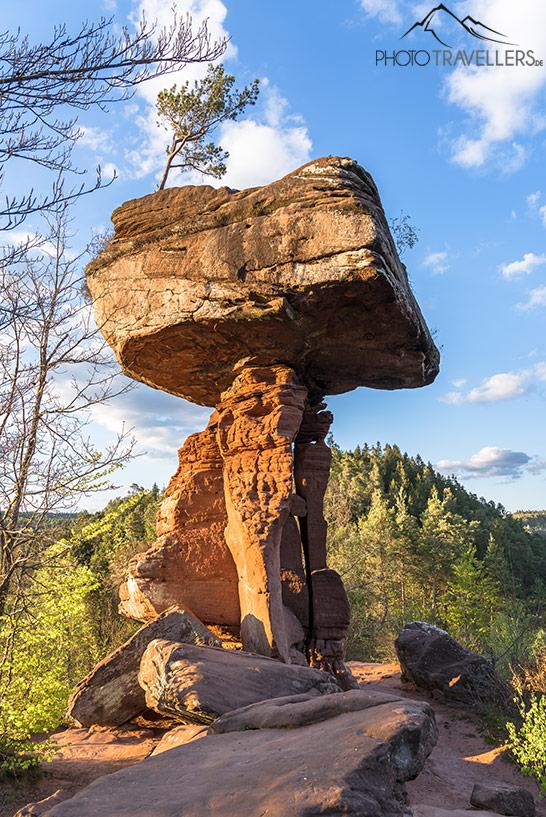
Even the name sounds devilish. The Teufelstisch is a massive boulder that actually looks like a table. Did the devil play a role here? Well, according to a legend, yes.
The Teufelstisch in the adventure park of the same name is located in the municipality of Hinterweidenthal. Three climbing routes lead up to the 14-meter-high giant, which weighs around 300 tons.
But this rock formation made of sandstone is exciting not only for climbers. It also offers a great motif for photographers. The Teufelstisch is a really cool attraction in the Palatinate Forest.
Tip: By the way, there are several great trekking spots in the Palatinate Forest.
2. Altschloss Felsen
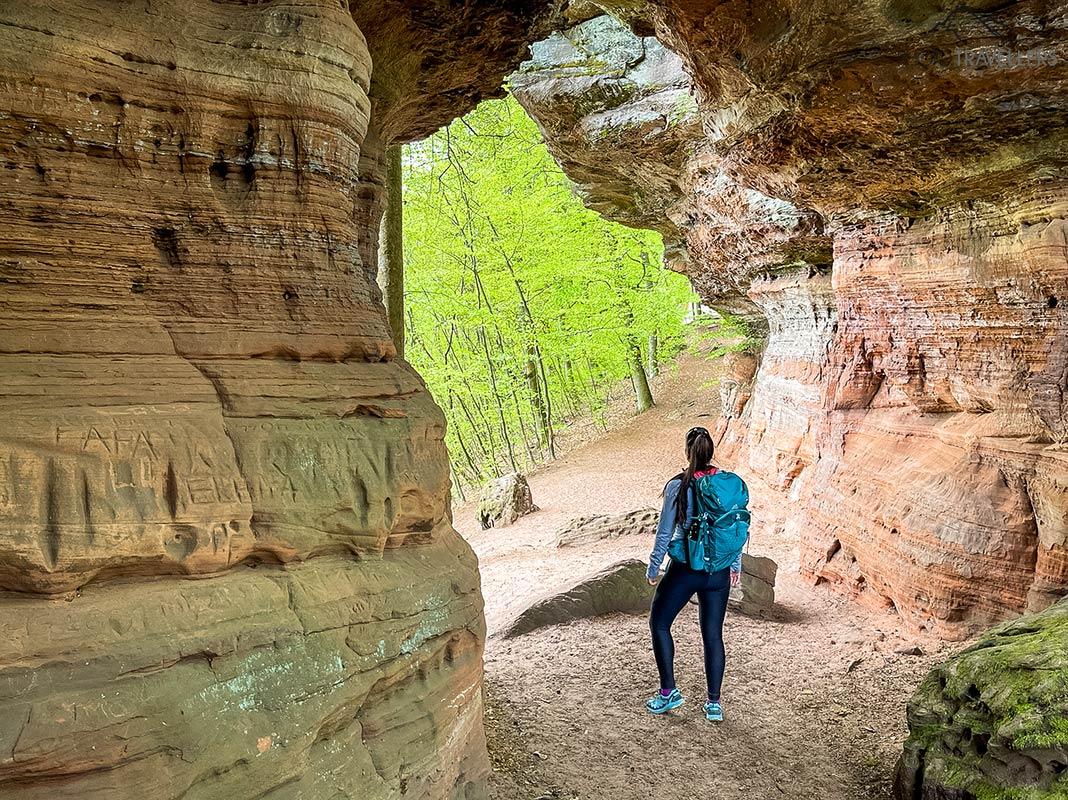
They are THE Instagram hotspot in the Palatinate Forest: The Altschloss Felsen. They almost lie right on the border to France. The striking sandstone formations at Brechenberg in Eppenbrunn are absolutely worth seeing. Especially along the German-French border, many of these formations present themselves beautifully.
They are not only a natural monument but also a cultural monument. They are also the largest rock formation in the Palatinate. Up to 30 meters, these crazy figures of rock wind their way up to the sky. They are a top attraction that you shouldn't miss.
We once hiked around the Altschloss Felsen. Along the way, you will also encounter the border stone to the German-French border. The entire area is perfect for the whole family. It is truly fun to hike in the Palatinate Forest.
3. Reichsburg Trifels
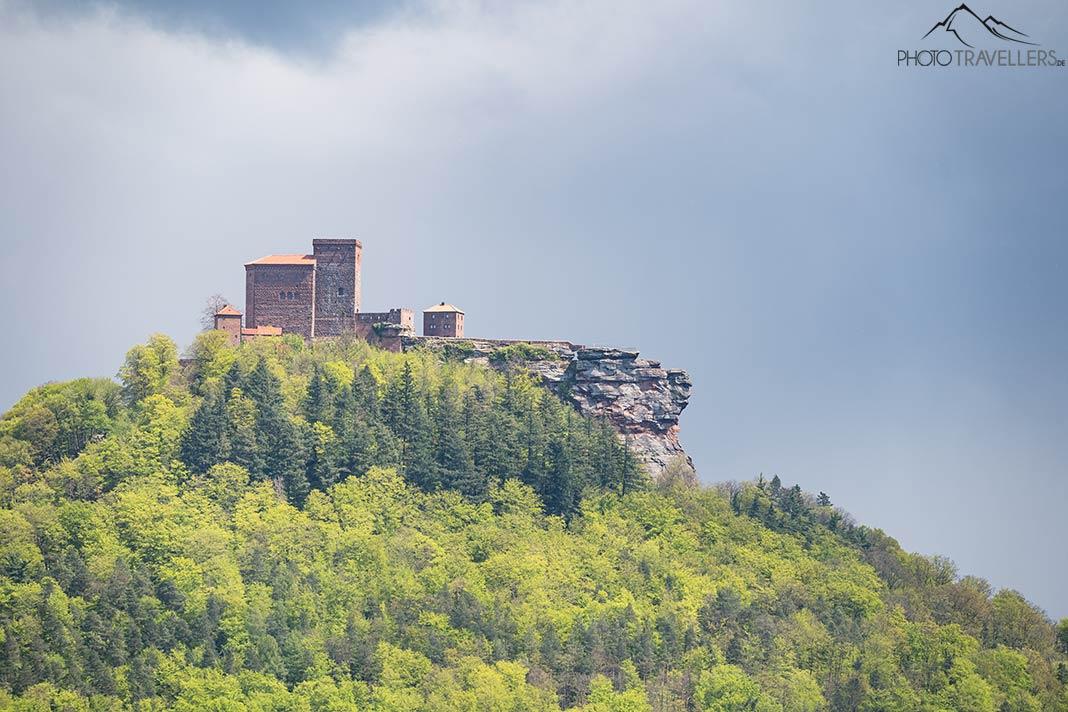
The Reichsburg Trifels towers high above the town of Annweiler am Trifels. It has been mentioned by name as far back as the 12th and 13th centuries. It was the residence of the Salian-Staufer dynasty. Since sandstone is available in the region, the castle was built from it. Thus, it still stands unwavering on the Sonnenberg, overseeing everything.
You must definitely climb up to the tower of the Reichsburg Trifels. The Trifels Erlebnisweg is a beautiful hike that takes you to the castle. We enjoyed it very much. From up there, you can look over the Rhine valley and the Palatinate Forest.
Right next to the Reichsburg Trifels, you will find the ruins of Scharfenberg Castle. The third ruin of the Trifels trio is the Anebos Castle. Together with the Reichsburg Trifels and the ruins of Scharfenberg, it constitutes the landmark of Annweiler. Only remnants of the medieval Anebos Castle survive today.
If you are in the area, it's worth making a detour to Annweiler. The small town invites you to dream with its many half-timbered houses. The romantic Staufer town even reminded us a bit of Venice. The Queich river flows through the second oldest town in the Palatinate at the water alley. On-site, you will find not only beautiful houses but also the old city mill, the tanning district, and the museum beneath the Trifels.
4. Hühnerstein
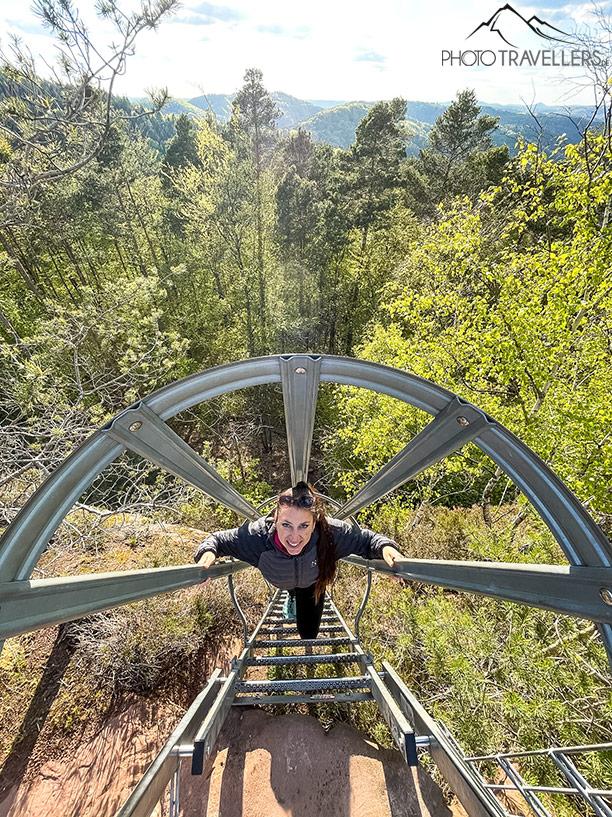
The Hühnerstein is a massive rock. It stands 12 meters high. Since 1970, you can climb this giant via a steep ladder. Interestingly, the name is derived from Hünenstein.
From the top, you have a magnificent view of the Palatinate Forest. You will pass the Hühnerstein when you hike the Hauensteiner Schusterpfad or the Hauensteiner Höhenweg.
The view from the Hühnerstein is definitely worth it. Standing up there on the platform would surely delight you.
5. Geiersteine
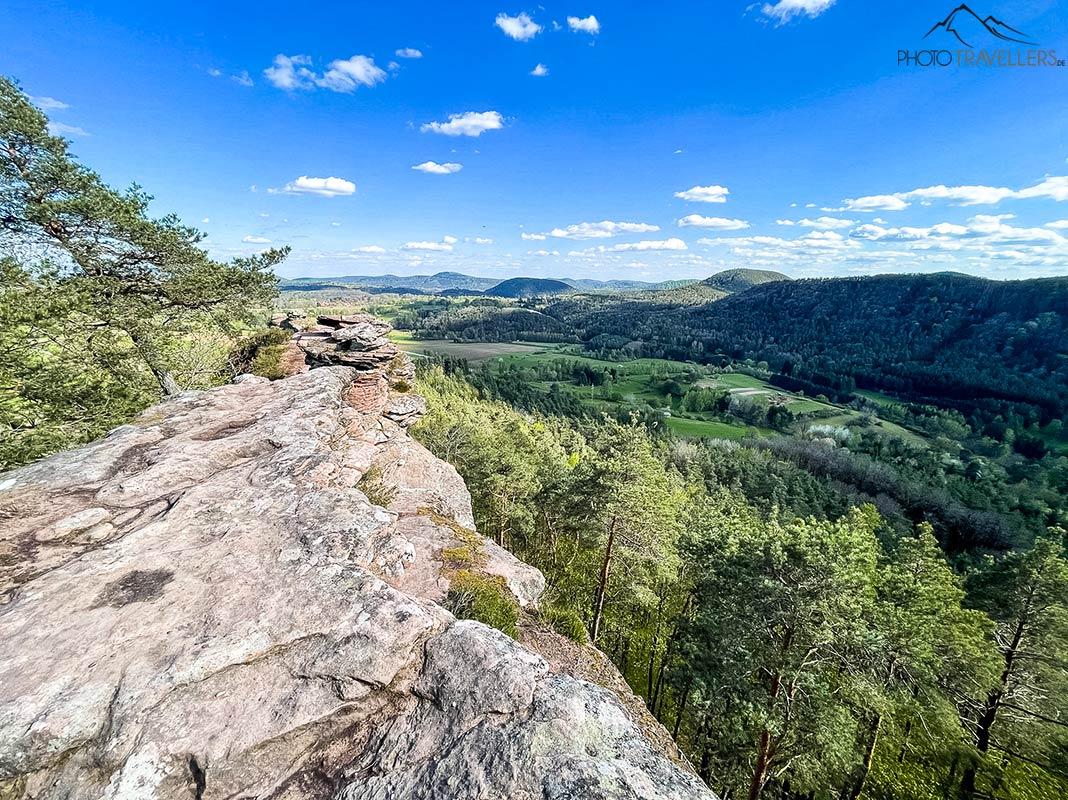
The Geiersteine also impressed us. A short hike leads you to the massive rock wall in the forest.
Via a winding path, you can quickly reach the top. Then you stand right on the Geiersteine, and a magnificent view of the Palatinate Forest opens up before you. It is truly impressive. No wonder the Geiersteine are considered the most beautiful viewpoint in the Palatinate Forest.
We sat on the platform for about an hour, totally enchanted by the beautiful view that was presented to us here. You look over to the Trifels Castle near Annweiler, can see the wine region of the Southern Wine Route, and below you lie small villages like Lug.
Now and then, you hear the click of climbers securing themselves. Otherwise, complete silence reigns here. Gentle hills and green forests stretch out before you. By the way: From a distance, the Geiersteine resemble a dragon.
6. Kalmit
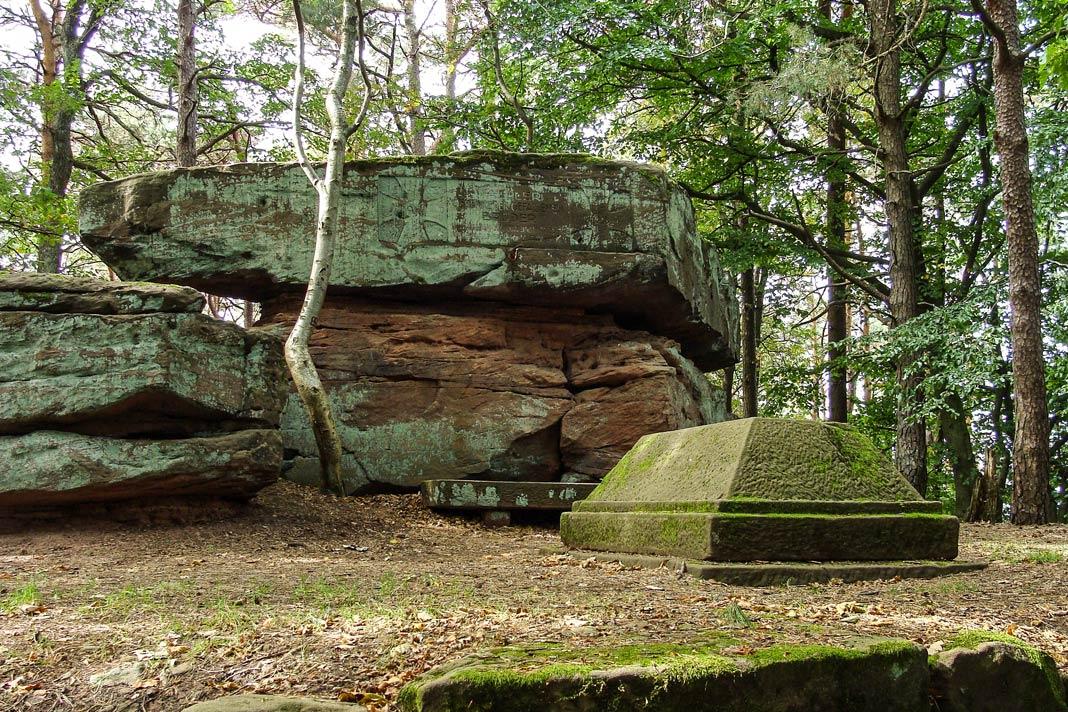
The Kalmit is a viewpoint mountain in the Palatinate Forest. Specifically, in the Haardt, on the eastern edge of the forest area. It is the highest mountain in the Palatinate Forest, and you definitely shouldn't miss it.
From up here, you enjoy a magnificent view over the Palatinate. After visiting the observation tower, you can take a detour to the Kalmithaus. There, you will find delicious Palatine food.
On the Kalmit, there is also a weather station and a visibility measuring station.
By the way, there is also a natural monument on the Kalmit. On the fore summit, the Hüttenberg, lies the Hüttenberg rock sea. The Kalmit is a top attraction.
7. Karlstalschlucht
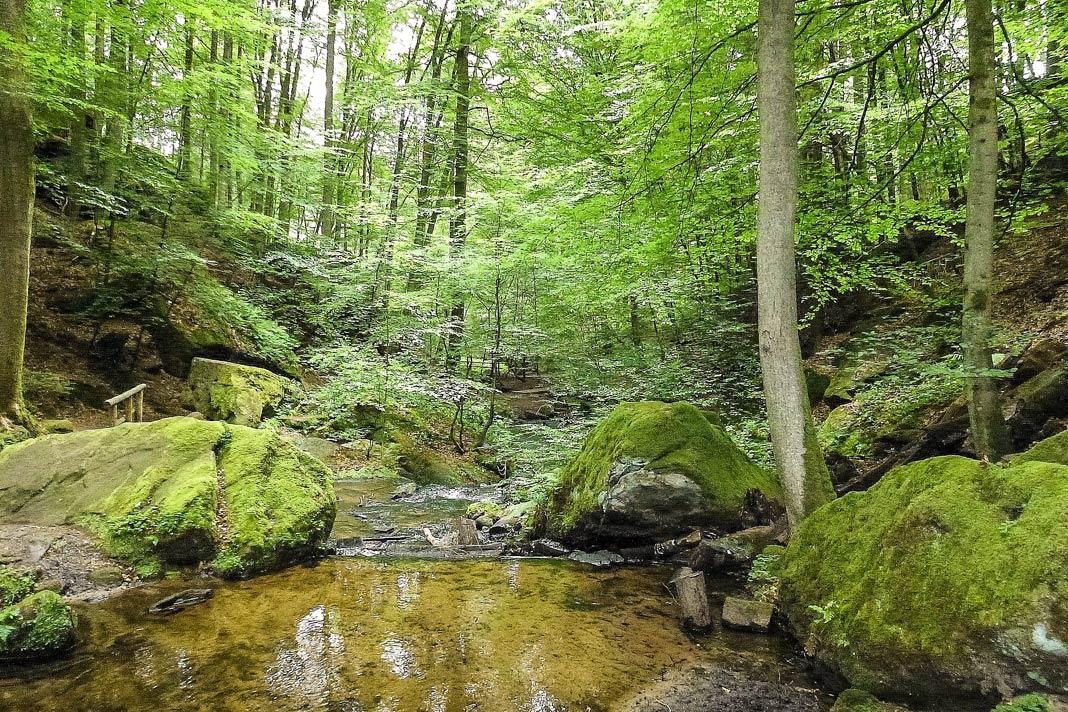
The Karlstalschlucht is said to be one of the most beautiful places in the Palatinate Forest. It is located directly in the Karlstal of the same name. You can walk along the Moosalbe stream or on wooden bridges here.
Especially families like to come here in the summer. There are many benches in the shade to relax, and you can dangle your feet in the wild stream.
A small wooden pavilion also stands in the gorge. It is the showcase of the area and a popular photo motif. The gorge ranks among the top attractions of the region.
You can park at the free parking lot Oberhammer.
8. Burg Landeck
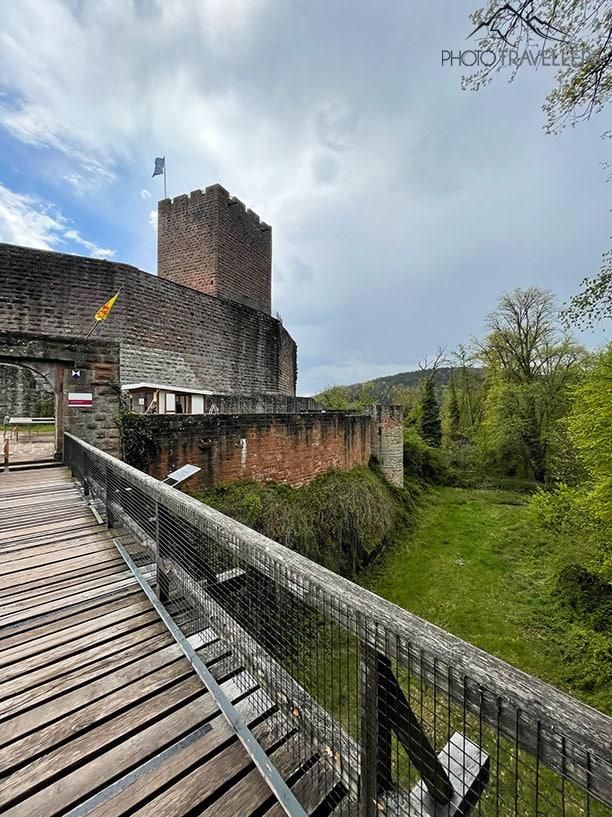
The Burg Landeck is a castle that could compete with Burg Eltz in its external appearance. An old wooden bridge leads to the gates of the castle. Inside, there is a beer garden with the Landeck tavern. The castle overlooks the village of Klingemünster.
By the way, the castle is one of the most famous in the Palatinate. If you are looking for a great view of the Rhine Valley, Burg Landeck is the place to be.
9. Westwallmuseum
The Westwallmuseum Bad Bergzabern is located at the edge of the Palatinate Forest. The location was strategically good for the bunkers from the Nazi era. In the museum, you can view the last three preserved bunkers from that time.
During the period of 1944/45, the Westwall meant that the Allies cautiously approached the German border.
The museum is accessible every second and fourth Sunday of the month from May. It is also open on holidays. Always from 11 AM to 5 PM. Adults pay 4 euros.
10. Schloss Kropsburg
The Schloss Kropsburg is highly frequented, especially for its beautiful beer garden in the summer. No wonder, the castle is located in the shady woods, surrounded by vineyards.
The garden with the castle tavern is located in the so-called outer castle. The food here is said to be very good. For hikers, it may be interesting that you can also stay here. There are 6 guest rooms available in the holiday apartment.
The parking lot is located at the foot of the mountain. You can either walk up the paved road or take hiking trails. You will then arrive at the Lourdes grotto via the pilgrimage path. The Schloss Kropsburg is a very popular attraction.
11. Wolfsschlucht
The Wolfsschlucht is a short but very beautiful hike. Here, you will also encounter the sandstone formations we know already. You hike through rocks covered with moss. There is also a spring with fresh spring water - perfect for a hot summer day.
A nice hike is, for example, from the Elmsteiner valley to the Wolfsschlucht through the Breitenbachtal. Along the way, you will pass old wooden rafting facilities. In the past, wood was floated down the river. That was hard and not safe work, for which various precautions were taken at the rivers. It is 4 kilometers to the popular Wolfsschluchthütte.
By the way, the Breitenbach springs at Waldhaus Schwarzsohl. This hut is also very popular in this region. You can reach the starting point of the tour in the Elmsteiner valley with the Kuckucksbähnel, which travels between Neustadt and Elmstein. The hike is an absolute attraction.
12. Rietburg
High up on the Blätterberg lies the Rietburg. Here we are back in the Haardt, on the eastern edge of the Palatinate Forest. Although only parts of the shield wall and the outer bailey of the castle remain, the ascent to the castle is worthwhile because it is a well-visited attraction.
The ruins are said to date back to 1200. Unfortunately, it was destroyed during the Thirty Years' War. To preserve the castle, a castle tavern was built in 1955, which is now very popular.
From up there, you also have a fantastic view of the Rhine valley. For many, a highlight is a ride on the Rietburgbahn, an old chair lift that has been transporting visitors to the castle since 1954.
You can park near the Schloss Villa Ludwigshöhe. None other than Ludwig I, King of Bavaria, had this castle built. Currently, there is construction going on, and it seems less attractive to visit the castle (as of summer 2020). It was built from 1846 to 1852.
13. Orensfels
A very powerful and beautiful viewpoint is the Orensfels. Here, a viewing platform has also been built on the rock with a railing.
Above the rocks pulls the natural monument Ringwall. In addition to this ring wall, excavation sites have discovered remnants of settlements from the early Middle Ages. This allows you to admire ancient stone sacrificial bowls that are overgrown with moss. Arrowheads from the Neolithic period were also found.
The Orensfels and the Orensberg must have attracted people long ago. We call this type of mystical places 'power places.'
14. Klosterruine Limburg
The Klosterruine Limburg is a former Benedictine abbey. Its history dates back from the 11th century to the Reformation. The ruins are frequently visited because they are one of the largest monuments of early Salian architecture. Thus, it is a top attraction in the Palatinate Forest. The Salian dynasty was an East Frankish noble family that existed during the 10th century.
The ruins rise elevated out of the Palatinate Forest. Beneath it flows the Isenach River. Behind the monastery begins the nature reserve Haardtrand - Am Limburgberg. In the past, the monastery served as a castle to protect the Isenach valley.
Tip: From June to August, open-air events take place at the Klosterruine. If you want to enjoy concerts, theater, and opera performances, you can experience them in this wonderful setting. You can find all information about the Limburg Sommer on the Bad Dürkheim website.
15. Burgruine Spangenberg
The Burgruine Spangenberg is a historical attraction located in Neustadt an der Weinstraße. It is a so-called medieval spur castle. Right next door is the Erfenstein Castle.
The two castles are connected by a legend. Supposedly, a bridge made of leather once spanned from castle to castle, made by two friendly castle lords who quarreled, which led to the Spangenberg lord cutting the leather straps. The Erfenstein lord died in this conflict.
The Spangenberg Castle is said to have been built in the 11th century. It was completely destroyed during the Thirty Years' War. Now, you can visit a reconstructed ruin.
16. Asselstein
Another great sandstone rock is the Asselstein in the Palatinate Forest. It is mainly a top attraction for climbers. 80 routes lead up to the massive rock. Thus, it is one of the most sought-after climbing destinations.
The Asselstein is 60 meters long and 10 meters wide. The rock cliff is 58 meters high. For resting, after your climbing tour, you can visit the climbing hut Asselstein.
17. Burg Altdahn
The Burg Altdahn in the Wasgau of the Palatinate Forest is part of a trio of castles, the Dahner Burgengruppe. The Grafendahn and Tanstein castles were built next to each other on the mountain.
Burg Altdahn is said to be from the 13th century. It partially survived the Thirty Years' War but was completely destroyed during the Palatinate War of Succession. The composer Felix Mendelssohn Bartholdy visited the castle ruins and painted them.
Today, you can visit the area freely. If you are interested in the museum, you must announce your visit by phone. The museum charges an admission fee. The phone number is 06391 3650.
18. Burgruine Frankenstein
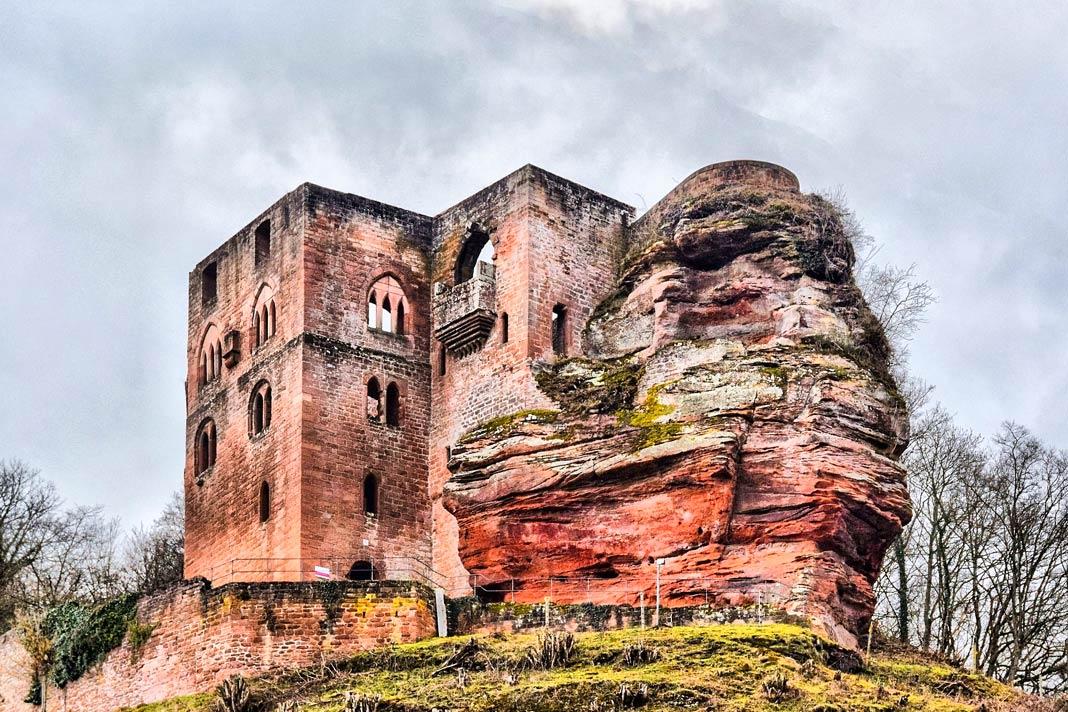
Above the town of Frankenstein stands the same-named Burgruine Frankenstein. And no, the name has nothing to do with the monster. The town belongs to the municipality of Kaiserslautern.
The castle is located on the Schlossberg. Right next to it is a distinctive sandstone rock.
What you can still visit today are the remains of a hall building, the so-called Palas. Especially the beautiful windows hint at a magnificent structure. Our tip: Look from the outside in. This will make the grandeur of the building even more evident.
19. Hexenklamm
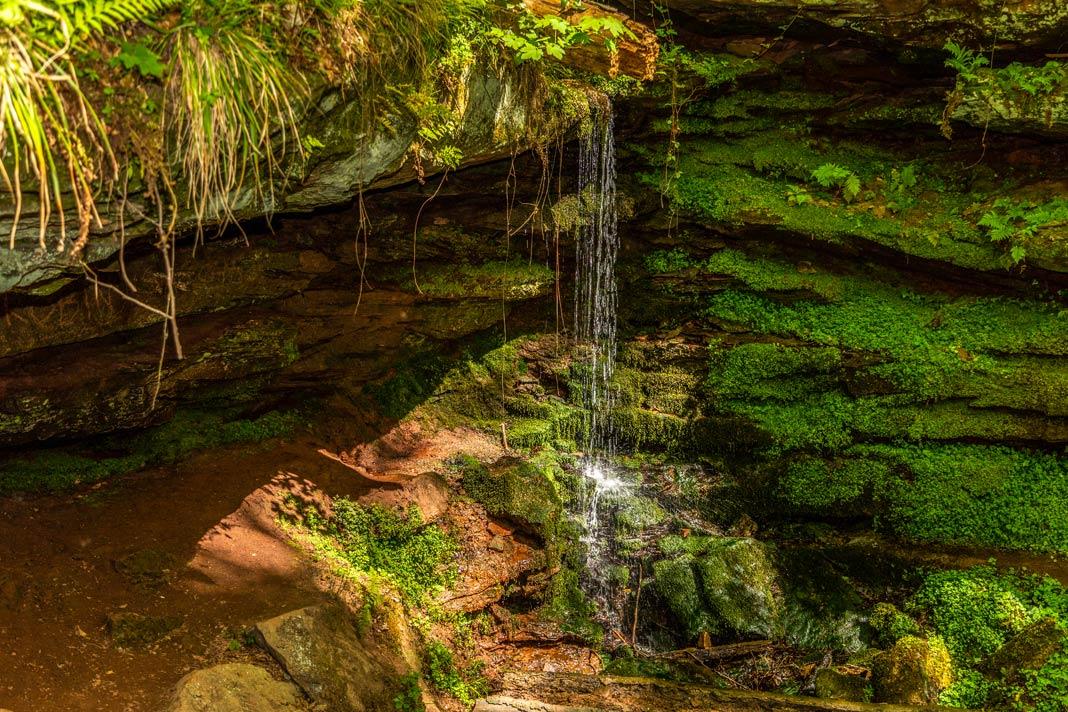
The Hexenklamm in the Palatinate Forest sounds adventurous. According to a legend, a coachman, who had drunk too much, tried to walk through the gorge at night. The witches played a trick on him, causing him to keep walking through the gorge repeatedly. Or maybe it was simply due to the alcohol?
Nevertheless, the Hexenklamm has an air of a fairy tale. In total, you will be traveling 6.5 kilometers. It will probably take you close to two hours because you will want to take many photos. Water drips everywhere over stones covered with moss. Don't let yourself be too enchanted.
20. Naturdenkmal dicke Eiche
A beautiful hiking trail leads to the natural monument thick oak. You start at the Belmontplatz parking lot, pass a Marterl, and reach the Winterkirchel. Soon you will reach the thick oak. A giant oak trunk lies on the ground.
Apparently, it lived to be over 300 years old. It stood 27 meters tall and had a circumference of over 5 meters. Once, charcoal was burned here, as an inscription reveals.
Directly near the natural monument is the hut Wanderheim Dicke Eiche.
If you are still fit, you can continue hiking to the Honey Rock. This is a beautiful sandstone formation. The hike to here takes 6 kilometers in one direction. You will return to the parking lot via the Bärenbrunner Hof. In total, you will be hiking just over 11 kilometers.
Additional Information
Tips for Family Outings in the Palatinate Forest
Now I will show you two more excursion destinations that are particularly suitable for families. The Zipline Park Elmstein welcomes you with 18 rope courses for kids and adults alike. Fun is guaranteed. You can find more information on the operator's website.
The Kurpfalzpark Wachenheim is an amusement park for families. You will find countless rides, a free-flying show, and a wildlife park with wolves. You can find all the important details on the park's website.
I hope my trip with you to the Palatinate Forest has been enjoyable. Germany's largest forest should be at the top of your list of sights in Germany. We particularly enjoyed the many castles that you can visit here.
The hikes in the Palatinate Forest are also very beautiful. The highlights, such as the Teufelstisch, Altschloss Felsen, Burg Trifels, Hühnerstein, and Geiersteine, make the Palatinate Forest a truly special experience.