The sunny and clear skies on Thursday morning made me get out of bed like a spring. There is nothing better than a good sun to wake up with spirit, enthusiasm and excitement. I was exultant and happy to be able to enjoy a city like Seoul, which still had a lot to offer me. The plan had enough attractions not to get bored and besides, there were not even 24 hours left to achieve one of the most important travelling challenges of my life, to enter the impenetrable North Korea for a day. That is, of course, if nothing and nobody prevented me from doing so, because the only thing I could rely on was that it was the 17th of July.
Embarking on a day trip through the heart of Seoul reveals a multifaceted city that seamlessly blends religion, politics, history, and commerce. To craft a comprehensive itinerary, I devised a three-phase plan that encompasses diverse experiences.
First, we start the day with a visit to Inwangsan Hill, an area of Seoul known for its shamanist roots. This spiritual quarter offers a glimpse into ancient traditions, showcasing a fascinating facet of the city's cultural heritage. Fueling our curiosity further, we then head to Seodaemun Prison, a stark reminder of Korea's tumultuous past under Japanese occupation. Here, the walls echo the cries for independence, providing a poignant visual representation of the country's history.
In the second phase, we delve into the monuments of the Joseon Dynasty, a pivotal era in Korean history. These architectural marvels bear witness to a powerful empire that left an indelible mark on the nation. As we navigate the city, a rich tapestry of stories and struggles unfold, immersing us in the very essence of Seoul's past.
Finally, we conclude the day with a touch of modernity by venturing into Insadong, a bustling shopping district that embodies the city's vibrant commercial scene. Here, traditional crafts, quirky boutiques, and delicious street food converge, offering a sensory overload of colors, scents, and tastes.
Our itinerary not only traverses Seoul's most traditional sites, but also reveals the city's progression through time, highlighting its ability to embrace both tradition and modernity. Join me on this immersive journey, as we unravel the layers of this captivating city.
Exploring Inwangsan Hill and Seodaemun Cabin: While seemingly unrelated, these two destinations share the same starting point - Dongnimmun underground station on Line 3. I chose to visit Inwangsan Hill first, exiting the station at Exit No. 2, as the remaining exits lead to the opposite side of the road and are more convenient for accessing the historic Seodaemun Prison. Inwangsan Hill holds great significance in South Korea, as it is regarded as a prominent hub of shamanism.
South Korea, with its rich Buddhist tradition, also holds the ancient rituals practiced by shamans in high regard, separate from their Buddhist beliefs. Unlike other regions in the world where different belief systems intertwine, such as the Americas and Africa, the Korean Peninsula maintains a distinct separation between Buddhism and shamanism. Many Korean individuals proudly identify as both Buddhists and shamans, embracing the unique characteristics of each tradition.
Embarking on this journey will not only allow you to admire the breathtaking beauty of Inwangsan Hill but also gain a deeper understanding of the cultural and spiritual narratives that shape South Korea's identity.
For the believers of this ancient philosophy or practice, our world is dominated by a large number of invisible spirits, both good and evil, who intervene in our lives and in everything around us. These spirits can only be contacted by shamans, who act as mediators to communicate with them and thus influence them for good, and who knows if for bad. By performing a variety of rituals, they are able to enter into a trance and thus interact with the afterlife, boasting a knowledge of supernatural forces and a unique and miraculous ability to interact with those floating, omnipotent souls that survive death. Shamanism in every region of the world has different traditions, different functions and different tools for communication with spirits. It is not the same in India as in Cuba or Côte d'Ivoire. In Korea, in particular, shamans are mostly women (Mudang), leaving very few men (Baksoo Mudang) to carry out these practices.
These characters, generally of low social class, in order to become shamans have had to inherit the knowledge of their ancestors, or have been chosen by the spirits, in addition to possessing a series of very complex vital characteristics such as:
> Having suffered a long illness with psychological overtones that have even led them to stop eating and even to wander aimlessly and without reason. Their illness, supposedly caused by spirits, must have been cured without the intervention of medicine. Subsequently they must have gone to learn at the house of a Mudang or Baskoo Mudang who showed them how to perform the rites. This case is not at all obligatory for those who have become shamans "by inheritance".
The ability to partake in ancient rituals associated with communicating with the afterlife is both intriguing and significant. This remarkable skill is a direct result of living in close quarters with esteemed shamans who possess deep spiritual knowledge and understanding.
To gain the recognition of the people as a revered religious leader, these shamans act as intermediaries between humanity and the ethereal realm. Utilizing a combination of rhythmic dance, entrancing percussion music, and the aid of hallucinogenic plants, these colorful figures transcend into a state of ecstasy. It is during this heightened state of consciousness that they implore the wandering spirits to bring forth prosperity, happiness, and healing to the community. They even act as guardians, guiding the departed souls on their passage to the afterlife.
To fully appreciate the captivating cultural practices of rituals and the enchanting role of shamans, one must embark on an immersive journey to experience the beauty and mystique of destinations such as Seoul. By delving into these rich traditions, travelers can gain a profound understanding of the deep-rooted spirituality that permeates through the vibrant streets and ancient landmarks of this mesmerizing city.
Shamanism, which has existed in Korea since ancient times, persists today with considerable force and, on a daily basis, in the smallest villages or in the most populated cities where rituals of the most varied and exotic from a Western point of view are performed.
On Mount Ingwangsan, there are places where it is possible to see or hear the ceremonies, although as they usually take place at night, they are not very easy to witness. Ingwangsan, moreover, does not seem to be a very friendly neighbourhood, and walking around in the wee hours of the morning must be imposing to say the least. Especially if you go alone. In the morning, on the other hand, the silence is sepulchral and clings to your neck. When you leave the metro (exit 2), take the first street on the left that slopes downhill. In this neighbourhood, the gradient is quite steep and, whether on stairs or paths, the climb is tiring, especially in summer when the drowsiness and humidity get the better of you. The beginning of the "shamanistic quarter" can be seen as the gate of an old Buddhist temple.
The pathway, featuring a combination of concrete and clay flooring, curves its way up a steep and narrow flight of stairs. From this vantage point, one can marvel at the breathtaking vistas of Seoul's sprawling metropolis, all while experiencing the serenity found in a place untethered by the echoes of bustling footsteps or the shutting of doors. Upon reaching the exquisite bell of the quaint Bongwonsa Buddhist temple, whose history dates back to 889 AD, it becomes apparent that the Inwangsan neighborhood offers a distinctive departure from the typical urban landscape.
Located in the heart of Seoul, Inwangsan presents an intriguing contrast to the bustling cityscape. As you traverse the path up the hill, you can soak in the awe-inspiring views and the tranquility that envelops the area. It is an escape to a different world, one where the rich history and spiritual roots of the temple blend effortlessly with the natural beauty of the landscape. As you explore the wonders of Bongwonsa and its surroundings, you'll gain a deeper appreciation for the harmonious coexistence of tradition, nature, and the vibrant city life that defines Seoul.
Seoul, the vibrant capital of South Korea, is a city that exudes a unique and captivating atmosphere. Whether it's the commanding presence of ancient reliquaries, the flickering candles or the humble altars adorned with water and dishes, there is a sense of reverence and tranquility that permeates the air.
Here in Seoul, both the teachings of Buddha and the presence of ethereal spirits seem intertwined, creating an enchanting harmony. These spiritual essences are invoked and celebrated throughout the city, weaving together a tapestry of faith and tradition.
As the morning unfolds, a stillness envelopes the streets, carrying echoes of the previous night's enchantment. The rhythmic beats of a drum, and the ethereal shuddering of a shaman, have become part of the mountain's magical symphony.
Indeed, Seoul is a city where the mystical and the tangible seamlessly intersect, beckoning visitors to immerse themselves in its captivating aura. Whether exploring ancient temples, indulging in mouthwatering street food, or strolling through vibrant markets, Seoul's charm lies in its ability to transport you to a world of wonder.
Inwangsan is said to have always been a place populated by tigers (during the Joseon period it was called White Tiger Mountain), although now the only existing traces of the voracious felines are some drawings on the thin wooden walls of temples or houses. Everything here is spirituality, and even more so when you continue to climb the exhausting stairs that never end. From the bell, if you spend three or four minutes of uninterrupted ascent, you reach an esplanade that can be considered the heart of this peculiar neighbourhood born on a hill.
Located on Mount Namsan, several kilometers from Inwangsan, lies the fascinating site of Guksadang, an ancient shamanistic shrine that dates back to 1395. Originally constructed to honor King Taejo, the first ruler of the enduring Joseon Dynasty, this sacred place was tragically dismantled by Japanese invaders in 1925. Fortunately, it was later reconstructed and relocated to its current spot, where it continues to be revered and diligently cared for by the local residents.
Within the shrine, I caught a glimpse of numerous altars adorned with offerings of food and drink, a humble gesture rooted in the belief that these tokens nourish the spirits residing here. Both inside and outside the shrine, a multitude of altars stand, ensuring that the spirits are never left wanting. It is believed that should they ever lack anything, their displeasure would be aroused.
If you wish to delve into the rich history and spiritual traditions of ancient Korea, a visit to Guksadang is a must. Immerse yourself in the awe-inspiring presence of King Taejo and his loyal generals while admiring the beautiful altars filled with heartfelt offerings. With every step, you'll gain a deeper understanding of the enduring cultural heritage and profound spirituality that continues to thrive in this remarkable place.
I found this place a little disturbing. I had a rather peculiar feeling of uneasiness and distrust. On the one hand, I was the only western foreigner visiting the area, and on the other, I imagined very filmy scenes of rituals with shamans invoking spirits. The basic ingredients for me to hit my head and fantasise about unsettling thoughts that, in reality, made no sense and had no reason.
As I ascended the staircase, my attention was caught by the peculiar shapes of two rocks that seemed to reach out to the sky. Consulting my trusty guidebook, I quickly identified them as the renowned Zen Rocks, held in high regard by the local population. Known as Seonbawi in Korean, their outlines bear a striking resemblance to two revered monks. Local lore suggests that these rocks are the petrified forms of King Taejo, the first ruler of the Joseon Dynasty, and his wife. However, others believe that they embody Buddhist monks who possess the power to grant wishes. This is evident from the visible evidence of numerous requests for good fortune engraved upon the rocks.
Unveiling a fascinating blend of legend and tradition, these enigmatic Zen Rocks hold a special place in the hearts of the people. Exploring the rich cultural tapestry of South Korea, visitors can immerse themselves in the captivating stories surrounding these enduring geological formations. Whether one seeks blessings, a connection to the past, or simply the opportunity to marvel at the forces of nature, the Seonbawi offers an unforgettable experience.
As I reached the Zen Rocks, I found myself at the summit of my journey. Although I could have continued my ascent to explore the ramparts, time was limited, and I decided to retrace my steps. Descending through a different path, one that was not recommended for those with unsteady footing, a curious sight awaited me. I stumbled upon a man deeply engrossed in prayer before a fascinating figure carved into the rock, unlike anything I had seen before. Intriguingly, this sculpture appeared more representative of a deity from Korean shamanism rather than a traditional Buddhist icon. The man's devout devotion and enchanting chants transported me into a realm where ancient beliefs merged with contemporary spirituality.
Seoul, often celebrated for its bustling metropolis and modernity, effortlessly intertwines traditional practices with the modern world. This unexpected encounter reminded me of the city's rich cultural tapestry, where hidden treasures can be found even amidst urban landscapes. Continuing my exploration, I eagerly anticipated the unique experiences that Seoul had in store, each unveiling a deeper understanding of Korea's fascinating spiritual heritage.
SEODAEMUN PRISON
Embarking on a journey back in time, I made my way to the historic Seodaemun prison, situated on the opposite side of the road from Dongnimmun underground station. This formidable structure stands as an enduring symbol of Korean Resistance and Independence, representing the indomitable spirit and resilience of the Korean people.
Visiting Seodaemun prison was an opportunity to delve into a significant chapter of Korean history. This former Japanese prison bears witness to the struggles and sacrifices made during the fight for freedom. As I stepped into the corridors, I couldn't help but imagine the stories etched within the walls; stories of resilience, hope, and the unwavering desire for independence.
Seodaemun, a prison built by Japan in 1908, served as a confinement facility for Korean political prisoners who fought for a free and independent Korea during Japan's occupation of the entire peninsula. Operating until the end of World War II in 1945, this prison housed numerous activists and individuals who would later be recognized as "Fathers of the Fatherland," enduring harsh conditions and silence to prevent any potential uprisings against the colonial power.
Despite its dark history, Seodaemun now stands as a symbol of resilience and serves as a vital reminder of the struggles faced by those who fought for Korean independence. With the passage of time, it has transformed into a museum, offering visitors the chance to gain a deeper understanding of the nation's past.
Punishment and torture were the order of the day, as were routine hangings. When the Japanese were defeated and expelled from the country and Korea became a Country of Law and Deed, the operation of the prison did not stop, although it did so from a South Korean perspective. It closed in 1987 when it was converted into a Korean Resistance Memorial Museum to show the world the atrocities committed by the Japanese there and to honour all those who fought for the nation's independence. Today it opens its doors (or should I say its cells) daily, except on Mondays, at half past nine in the morning, for a modest fee of 1500 won.
The explanations of each of the rooms and many of the personal stories of the Korean independence leaders are profuse. Like a house of horrors, it shows moving scenes of torture with life-size dolls of the prisoners and the evil Japanese villains, always depicted with a scowl and a devilish grimace on their faces. You can listen to recordings of screams or peek into a cell and see a bloody wax face. But perhaps one of the most disturbing spaces is in a room created in the image and likeness of the execution room (the real one can also be visited). There are dummies of judges next to soldiers and an executioner reading out a condemnatory sentence from the gallows. Right under the rope you can sit as if you were a defendant about to die. I did it and got one of the scares of my life when the evil Japanese judge hit the table with the gavel and the wooden chair seemed to collapse (a deliberate attempt to live the last seconds of a prisoner). One more attraction of this museum of horror where it is possible to walk freely through perfectly preserved pavilions and cells.
Walking through the courtyard, you can see how a gigantic Korean flag is still hanging from the windows of the central cellblock. The gallows hut, where the unfortunate condemned were executed, remains unchanged and intact in one corner of the prison. The same rope that broke dozens of necks swayed lightly in an almost non-existent gust of wind.
Seodaemun is a haunting and frightening prison that recalls days of pain, blood and suffering of the Korean people in their thirst for independence. It highlights the lack of respect for human rights at the time, an issue that eighty years after the founding of this Seoul prison continues to be fully respected in many countries around the world.
And if not, one need only go back to the terrible history of the Guantánamo or Abu Ghraib prisons of the day. Same Auschwitz with different collars. No one is safe.
* 2nd PHASE-> MONUMENTS OF THE JOSEON DYNASTY: In Seoul there are five important palaces under the Joseon monarchy that reigned in Korea from 1392 to 1910. That's just over five hundred years of holding the sceptre of a nation from the same throne. Needless to say, that is a long time for the imprint of this family to be present in all kinds of buildings, both civil and religious in Seoul and throughout Korea. And the palaces, which combined both residential and political functions, have come down to us in better or worse condition, depending on the case, as they have had to endure wars and fires, with pitiful effects. The "big five" are Gyeongbokgung, Changdeokgung, Changgyeonggung, Deoksugung and Gyeonghuigung, and have in common, in addition to the suffix -gung meaning "Palace", that they served at some point during the Joseon Period as the permanent or temporary residence of the leading members of the Korean royalty.
Gyeongbokgung and Changdeokgung stand out in terms of importance, size and length of time in use. Gyeongbokgung was the first Joseon Palace, built in 1395 and served as the royal seat until the first Japanese invasion in 1592 when it was burned to the ground. Until it was rebuilt 273 years later, it was Changdeokgung, located just a few kilometres further east, that took all the honours. As late as 1865, King Gojong, one of the last Joseon, returned to a Geongbokgung that bore little resemblance to the original, and was not fortunate enough to be spared Japanese attacks in the early colonial period around 1910. The other palaces never enjoyed the prominence of the first two and were relegated to other functions or other periods where they were used for short stays. Changgyeonggung was more of a garden and recreation area for Joseon women, and Deoksugung and Geonghuigung were merely secondary or temporary villas that were barely inhabited.
There is no denying that Korea has a turbulent history, marked by the Japanese invasions of the 16th and 20th centuries as well as its fratricidal war with the North, and that this is reflected in the preservation of the Joseon monuments. All the palaces can be visited to a greater or lesser extent, but of all of them there is one that has kept its spirit intact, which is why it was inscribed on the UNESCO World Heritage List in 1997. It is Changdeokgung, which in English means "Illustrious Palace of Virtue", the most beautiful of all the palaces in the South Korean capital. If the traveller had to choose one of the five palaces, this should be the only possible choice. The others may be of relative interest for longer stays, but anyone who does not penetrate the walls of Changdeokgung and its secret garden will not be able to say that he has been to Seoul and seen with his own eyes one of the most beautiful and impressive monuments on the entire Asian continent.
I chose for that Thursday both Changdeokgung and Changgyeonggung, together but divided by a grey wall. Just a five-minute walk from Anguk, the line 3 station very close to my hotel, I arrived at the gates of Changdeokgung and inquired about visiting hours and prices. I have to say that the fame and beauty of this place is commensurate with the strict limitations of the visit as well as the higher-than-normal fee. I'd better explain this in more detail for those planning a trip to Seoul to take note (Information collected in January 2009):
- The Palace is open on all days of the week except for Mondays. Guided tours are available at all times, except for one specific instance which I will elaborate on later. Visitors have the option of embarking on 80-minute tours in Korean (occurring every half hour), Japanese, Chinese, and English, each following a distinct schedule. For those particularly interested in English tours, they take place three times a day, year-round, at 11:30 am, 1:30 pm, and 3:30 pm.
Now, allow me to share an intriguing exception that I happened to stumble upon during my visit. From April to October, visitors have the unique opportunity to explore the Palace sans a guide, exclusively on Thursdays. However, I must note that the cost for this particular experience is higher compared to the organized tours, but the chance to wander freely within its historic walls is truly worth it.
Exploring the fascinating historical sites of Seoul can be done through guided tours, which offer unique insights into the gardens and royal rooms, making it a worthwhile experience. For adults aged 19 to 64, these tours cost 3000 won, while young people aged 7 to 18 can join at a discounted rate of 1500 won. Notably, children aged 0-6 and those over 65, as well as individuals with disabilities, can enjoy these tours free of charge.
For those who prefer to traverse Seoul's attractions without a guide, it's important to note that the price increases significantly. In fact, the cost multiplies by five, resulting in a rate of 15000 Wones for adults and 7500 Wones for young people between 7 to 18 years old. This option can offer a more independent experience, allowing visitors to explore at their own pace and delve into the captivating history and culture found throughout the city.
As I am no longer a kid under 18, I had to pay the not inconsiderable amount of 15,000 Wones, which reminds me of what you pay for monuments in expensive cities like Rome or Paris. But on the other hand, I found it casual and magnificent to be able to walk around the Palace and its vast back gardens at my leisure. I don't like the shackles of a guided tour where you are rushing around, hearing facts that are sometimes of little interest, and not even being able to sit down for a while to enjoy what is around you.
Changdeokgung is known as "Eastern Palace", in reference to its location in respect to the first-born and main Gyeongbokgung. It was built in 1405 during the reign of Taejo, the first Joseon, as an auxiliary palace. Both were not too fortunate during the Japanese invasion of 1592 and were burned to the ground. While Geongbokgung lay in ruins for three centuries, Changdeokgung was rebuilt in 1609 without diminishing in size to be used as the main residence of the royalty and their court.
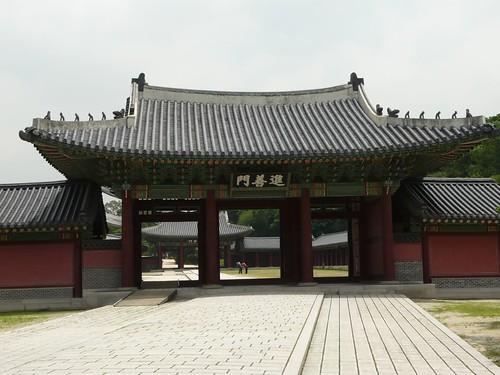
The stunning Donhwamun Gate serves as the entrance to the magnificent Changdeok Palace, dating back to the early 15th century. This historic structure, which has been rebuilt over the centuries, holds great significance and is a symbol of the influence and teachings imparted in the Joseon Kingdom.
As you pass through Donhwamun Gate, you embark on a captivating journey through time. Taking a stroll along the enchanting avenue, you'll come across a picturesque stone bridge named Geumcheongyo, leading you to yet another gate, Jinseonmun. This gate marks the beginning of your immersive exploration into the depths of the splendid Joseon Kingdom.
Within Changdeokgung's vast grounds, you'll discover a sprawling and awe-inspiring ensemble, consisting of different areas of significance. Each area offers its own unique charm and allure, contributing to the overall majesty of this historic palace.
To take in the grandeur of Changdeok Palace, don't miss the opportunity to traverse its magnificent gateways and experience the rich heritage of the Joseon Kingdom.
- The Throne Hall (Injeongjeon). Serving as the largest structure within the palace grounds, the Throne Hall offered a majestic setting for Joseon Kings to receive foreign ambassadors and emissaries. This remarkable pavilion was surrounded by an expansive courtyard, exemplifying the opulence and splendor of the palace. Undoubtedly, it served as the beating heart of the entire complex.
- The administrative quarters (Seonjeongjeon). Distinguished by its enchanting emerald green walls and roofs, this pavilion captivated the attention of all who beheld it. The name Seonjeong carries significant meaning, symbolizing the execution of positive governance policies. Enacting critical decisions, the kings would gather within this pavilion, engaging in discourse with their trusted advisors.
Stepping into the Throne Hall, visitors are transported to a time when Korea's monarchs commanded the utmost respect and power. The sheer grandeur of the building embodies the majesty that once permeated the space, leaving an indelible impression on all who witness it.
- The royal chambers (Heuijeongdang and Daejojeon). The sleeping quarters of the King and Queen were separate, and unfortunately the original structures were destroyed during the Japanese invasion. However, the surviving apartments were relocated from Gyeongbokgung, and they still showcase the grandeur and opulence of the monarchy.
- The Enigmatic Garden (Huwon). Changdeok Palace was designed with the principles of geomancy in mind, aiming to create a harmonious blend of natural surroundings with man-made spaces. As you traverse the cobblestone paths, you'll be mesmerized by the seamless integration of lush vegetation. The real magic begins when you step away from the main buildings and enter the Secret or Rear Garden, which boasts enchanting scenery reminiscent of the oriental landscape art found in China and Japan. Here, amidst the tranquil woods, shimmering ponds, and elegant wooden pavilions, the monarchs and their court would often retreat for moments of introspection, meditation, and leisure.
Did you know that the royal apartments were relocated from Gyeongbokgung after the original structures were destroyed? This was done to preserve the regal atmosphere and provide visitors with a glimpse into the splendor of the past. Additionally, the Secret Garden, also known as Huwon, showcases the skilled craftsmanship and artistic prowess of the time, offering a serene escape from the bustling city of Seoul. Exploring this hidden gem allows you to immerse yourself in the beauty and tranquility that once captivated the rulers of Korea. Make sure to include a visit to these historic sites on your itinerary for an unforgettable journey through Korean history.
The vast expanse of the surroundings is truly astonishing, offering a serene escape along its narrow and tranquil paths. Exploring these areas reveals hidden gems like Buyongji, a captivating pond that was a remarkable accomplishment in its creation. Its rectangular shape represents the unique eastern perception of the world's form, while a small circular island at its center represents the heavens. Enveloping this harmonious setting are the mesmerizing reflections of lotus flowers and water lilies, adding to the allure of the pavilions that served as archives and libraries, among other purposes.
Furthermore, the significance of Buyongji extends beyond its aesthetic appeal. It serves as a testament to the ingenuity and artistic vision of the region. Visitors can immerse themselves in the cultural and historical significance of this stunning site, appreciating the intricate design that symbolizes a harmonious connection between the natural and celestial worlds.
Another place I visited with interest was Ongnyucheon, at the northeastern end of the Garden, where the kings and their officials took "zen" baths and read poetry. The murmur of the stream, as ceaseless as it is soothing, is a faithful companion to this very ancient and royalist spa.
I left Changdeokgung through the main gate in search of the other palatial compound around it, visible on the other side of a narrow wall. But it is such a detour that it seems impossible that they are so close together. Changgyeonggung is something like the little brother of Changdeok Palace. Built as a summer palace, it was once the residence of the monarch's concubines. During the Japanese colonial period it was relegated to a botanical garden, and a zoo was installed (nonexistent today). But today it once again enjoys an exquisiteness that makes it worth adding another dash of Joseon Monument binge.
And it's not the last, as from here an elevated stone bridge leads to the famous Jongmyo Shrine, dedicated to the spirits of the Joseon ancestors, and which attracts many, many people who stroll around it as if it were just another city park. But in reality it is another important piece of history and tradition because the ceremonial rites honouring the ancient Joseon are still performed there year after year since the Joseon moved the capital from Gyeongju to Seoul (1394). They venerate their centres because they see them as the building block on which the Korean nation is based. Music, orchestras, dances and prayers honour the most ancient fathers of the nation.
Tapgol Park in Seoul holds immense historical significance as it was the site where the Declaration of Independence was proclaimed on March 1, 1919. Serving as a national symbol, this park commemorates the brave individuals who fought for Korean independence from Japan. Today, the park stands not only as a solemn memorial but also as a social hub, reflecting the changing times.
Tapgol, which translates to "Pagoda Park," was originally a Buddhist temple. Within its premises, a remarkable ten-story stone Pagoda, dating back to the 15th century, stands preserved in glass. This ancient structure serves as a testament to Korea's rich cultural heritage and offers visitors a glimpse into the past.
Visiting the park not only allows us to pay our respects to the modern Founding Fathers who advocated for an independent Korea but also provides an opportunity to reflect on the sacrifices made by countless anti-Japanese political activists who were imprisoned and persecuted in the nearby Seodaemun prison.
After exploring the historic Tapgol Park and indulging in a well-deserved meal, I couldn't help but feel completely exhausted. The rigorous climb up the steep stairs of Inwangsan and my captivating visits to the magnificent palaces of the Joseon Dynasty had taken a toll on me. Recognizing my need for relaxation, I decided to dedicate the rest of the day to a tranquil activity - shopping and searching for souvenirs in Insadong.
Immense fatigue pushed me to seek solace in the comforting experience of leisurely browsing the various shops that lined the streets. With a desire to bring a piece of this vibrant city back home, I eagerly sought out unique gifts that would serve as reminders of my incredible journey throughout Seoul.
As I meandered through the colorful shops and boutiques, each offering an array of traditional crafts, artistic masterpieces, and Korean delicacies, I couldn't help but feel a sense of enchantment. From exquisite hanboks to delicate ceramics, Insadong presented a treasure trove of cultural artifacts that perfectly encapsulated the essence of South Korea.
Amidst the numerous options, I carefully selected a few treasures to bring back to Spain - symbols of the rich heritage and warm hospitality I experienced in Seoul. Immersing myself in the local art and craftsmanship was not only a pleasant diversion but also a meaningful way to support local artisans and preserve the cultural tapestry of the city.
With a renewed sense of tranquility, I left Insadong that day with a lighter heart and cherished mementos in hand. The memories of my exploration in Seoul would forever be intertwined with the treasured items that now adorned my suitcase, waiting to be shared with loved ones back home.
When it comes to shopping, I always save it for the end of my trip to avoid carrying around a heavy suitcase. However, I couldn't resist the allure of Seoul's bustling shopping scene. Just a short distance from Tapgol Park, there lies Insadong District, home to a plethora of art, antique, and souvenir shops in the capital of South Korea. It's impossible not to be captivated by the wide array of objects that pay homage to Korean tradition.
If you're a fan of unique and authentic souvenirs, Insadong District is the place to be. Whether it's traditional Korean artwork, antique ceramics, or charming mementos, there's something to suit every taste and interest. As you stroll down the main avenue leading to Anguk Station, you'll find yourself enchanted by the vibrant and bustling atmosphere, surrounded by thousands of objects that tell the story of Korean heritage.
In Seoul, the enchanting Insadong district can be likened to a sprawling tree, with Insadong Avenue acting as its sturdy trunk and the narrow streets as its delicate branches. Wandering through this lively neighborhood, one can't help but notice the distinct scent of plastic bags and wrapping paper lingering in the air.
Explore the captivating streets of Insadong, where traditional tea houses and antique shops coexist harmoniously. Immerse yourself in the vibrant atmosphere as you browse through an array of art galleries and boutiques, showcasing the rich cultural heritage of Korea.
During the Joseon era, aristocrats and members of the government resided in the Insadong neighbourhood. But since the last Japanese invasion, these people have been moving out of here, and many antique shops have sprung up, many of them owning items that until then had been in these noble houses. And so, little by little, it became a traditional place for this kind of transaction, with art dealers also setting up galleries to sell paintings and high-value collector's items. Today, according to the Seoul Tourism Board, 41% of South Korea's antique shops are located in this district. Alongside them, local handicraft and souvenir shops have mushroomed, where you can buy a hanbok (traditional Korean dress, something like kimonos in Japan), typical Hahoe or Andong masks used in theatre and dance, a tea set, or a Buddha more than a hundred years old. Porcelain and lacquerware of all kinds and prices sell like hot cakes. And souvenirs, as many as you like. The merchandising made in S. Korea has nothing to envy to that of many other more famous and touristy countries.
It is especially interesting to stroll through Insadong on Saturday afternoons and all day on Sundays because the traffic is cut off, completely pedestrianising this popular shopping area. I didn't have to wait long and rushed through my gifts on both Thursday and Saturday afternoon, with those classic last-minute purchases that left me almost without a single Won or space for my suitcase.
After carefully handling my finances, I found it necessary to take a brief rest in order to avoid dozing off in the midst of bustling streets. Grateful for the chance to recharge, I indulged in a quick power nap and a rejuvenating shower. As I connected to the internet to catch up on the latest updates, I wondered if news of the unfortunate incident involving a North Korean soldier and a tourist still dominated the headlines.
With only a few hours remaining until my adventure "to the other side," doubts lingered in my mind. However, no one had communicated any changes via email or phone, leaving me with no choice but to meet at the designated location at the appointed time. In anticipation of the journey, a mix of excitement and uncertainty filled the air.
During my evening in the Jongno neighborhood, which I thoroughly enjoyed, I made sure to visit the designated spot where the Gonsee agency vehicle would pick me up the next day for my journey into North Korea. To my surprise, there was a significant police presence, along with numerous armored buses barricading the street. The situation prompted me to approach a journalist in the area to inquire about the commotion.
It turned out that the commotion and heavy security measures were due to ongoing large-scale demonstrations against the government's decision to allow beef imports from the United States. While the issue may seem trivial, it had sparked a severe political crisis. As a result, riot police had been deployed to forcefully control the protesters, emphasizing the gravity of the situation.
These demonstrations were just one example of the liveliness and passion that can be found in the streets of Seoul. Exploring the city presented me with unexpected encounters and glimpses into the current concerns of its residents. It truly added depth to my travel experience.
I had no alternative but to change my direction in order to avoid any potential trouble. As a result, I decided to head towards the Holiday In Korea hotel, but before doing so, I made sure to purchase some food and beverages for breakfast the following morning. Before I made my trip, I had done some research about accommodation options in the area. I found some interesting options like Seoul apartments, but ultimately, the convenience of the hotel won me over. As per our prior arrangement, I had planned to meet the individuals from the agency at a specific location, which was a 25-minute walk from the hotel, at precisely twenty minutes to six in the morning.
Given the possibility that the streets might not even be fully developed at that early hour, I deemed it wiser to be cautious rather than venture into the Axis of Evil without having breakfast beforehand. It was of utmost importance to ensure our safety and well-being during this journey.
I would be lying if I said I slept well that night. I was close to one of my most dreamed-of challenges and, to be honest, I had no idea what I was going to find after crossing the Demilitarised Zone without a single mobile phone. Demands of the script, or rather, of what is probably the most hermetic Dictatorship on the Planet. And no one at home was aware of my plans. Why bother? I would tell them if everything went well... or not.
July 18th: TRIP TO THE AXIS OF EVIL. A DAY IN NORTH KOREA
This day deserves a separate chapter. Click here to read it.
July 19: A LAST DAY WATERY
Due to the inclement weather caused by an approaching typhoon in Seoul, my original plans for the day were put on hold. The heavy rain made it impossible to venture outside, so I decided to make the most of my time indoors and focus on writing the script for the captivating chronicles of Stories from the Far East: Journey to Japan and the 2 Koreas, which you are currently delving into. Amidst the downpour, I diligently organized my rucksack, sorting through various piles of notes and papers, ensuring that every piece of information I had gathered during the initial three weeks of July was accounted for. It was a task that required meticulous attention, a true testament to the importance and significance of this particular journey.
As I penned down the details of my adventures, vivid memories flooded my mind, transporting me back to the magnificent landscapes and captivating cultures of Japan and the Koreas. Although I longed to explore Seoul further on this day, fate had other plans, providing me with the opportunity to reflect and consolidate my experiences. The tempestuous weather outside served as a reminder of the unpredictable nature of travel, reminding me that even the most carefully planned journeys can be disrupted by the forces of nature.
Venturing out in the rain without a functioning umbrella, I decided to grab a meal in Jongno. Sitting on the first floor of a sparsely populated restaurant, I observed unsuspecting pedestrians braving the downpour and wind that relentlessly drenched their faces. It was a spectacle that could have easily made for viral videos, complete with slips and spills. Regrettably, I couldn't seize the moment to capture any footage on my camera.
The unpredictable weather in Seoul often poses challenges for locals and tourists alike, as seen in this comical yet cautionary scene. Despite the inclement conditions, the resilience of individuals to go about their daily activities is awe-inspiring. The incident served as a reminder of the vibrant energy that fills the streets of this bustling city, even during less-than-ideal weather.
Where I did get the chance to shoot video was in the evening when, out of the rain, I got right into one of the daily demonstrations against the import of American meat. I mingled with the Korean press in order to immortalise those tense moments. The most striking thing, apart from the running to avoid being run over and the occasional close-up view of the banging, was undoubtedly the mechanical and martial action of the National Police. It looked like a perfectly organised army that was positioned at different strategic points to ensure that nothing happened.
They were pumping themselves up by shouting different phrases in unison as if they were an American football team or by rattling their shields on the ground. They always moved from one side to the other all together at the same time. Countless and perfectly organised in large squads, they were marking the steps of the Demonstration, and they were snaring activists who crossed the line. I've never seen so many police together in my life, not even when the riot police are in Cibeles during Real Madrid's league celebrations to mitigate the party.
On July 20th, my adventure drew to a close with mixed emotions. As I bid farewell to Korea, my heart yearned for more time in this captivating land. A backdrop of raindrops on the windowpane mirrored my melancholy.
The journey back home presented its own set of challenges. At Incheon International Airport, I found myself in a predicament when my checked luggage exceeded the allowed weight limit of 20 kilograms. Shockingly, I was faced with a hefty 300 euro fee. Determined not to succumb to such an unreasonable charge, I devised a solution. With minutes to spare before boarding, I ingeniously purchased an extra travel bag to redistribute the weight, ensuring the big suitcase complied with the requirements. But the ordeal wasn't quite over yet, as my carry-on also surpassed the limits set by Air France.
As desperation began to creep in, I managed to salvage the situation by securing some adhesive tape. Carefully folding the bag that had to accompany me in the cabin, I seized the opportunity to alleviate further troubles. Ultimately, it was the innovative use of adhesive tape that granted me access to the plane, bringing this incredible journey to a close.
Regrettably, this marked the end of my journey, leaving me with a deep sense of sadness. In a mere 24 hours, both Japan and the vibrant cities of Seoul and its neighboring Korean counterparts would become cherished memories, brimming with captivating visuals and remarkable tales. As I sat on the plane, a single thought provided solace amidst the melancholy: What extraordinary adventure awaits me on my next expedition?
Although this chapter may have come to a close, the revelations and experiences gained from navigating the streets of Seoul and exploring the rich histories of Japan and the two Koreas remain ingrained within me. Fondly, I recall the awe-inspiring landscapes, enchanting customs, and the warm hospitality that adorned each step of my odyssey. No doubt, these reminiscences shall fuel my desire to embark on another captivating journey, where new horizons, undiscovered wonders, and unforgettable memories lie in wait.